 ultimate-guide
Best Skincare Routine for Pigmentation: AM & PM Guide
Table of Contents
- Why Pigmentation Needs a Targeted Routine
- AM and PM Skincare Routine for Pigmentation
- Best Ingredients for Hyperpigmentation
- How to Fade Dark Spots Without Irritation
- Professional Hyperpigmentation Treatment Options
- Common Mistakes That Worsen Pigmentation
- Conclusion
- Frequently Asked Questions
Last Updated: October 16, 2026
Why Pigmentation Needs a Targeted Routine
Pigmentation is not one condition, and that is exactly why a generic routine fails. Hyperpigmentation is the umbrella term for patches of skin that appear darker than the surrounding tone because melanin production has been triggered or concentrated in one area.
Three facts shape everything below:
- Melanin production is a protective response, not a defect. You are managing a process, not erasing a stain.
- Epidermal pigment sits in the top layers and responds to topical care. Dermal pigment sits deeper and often needs in-office treatment.
- UV exposure re-triggers the same cells you are trying to calm. Without daily SPF, every other step is wasted effort.
The American Academy of Dermatology's guidance on hyperpigmentation makes the same point: sun protection is the foundation, not an optional add-on.
That is the throughline of this guide. A skincare routine for pigmentation works only when it is built in layers: protect first, fade second, and never irritate the barrier in between.
AM and PM Skincare Routine for Pigmentation
The best structure splits your day in two. Morning is defense: antioxidants and sun protection.
Consistency matters more than intensity. A gentle routine followed daily outperforms an aggressive one you abandon in a week.
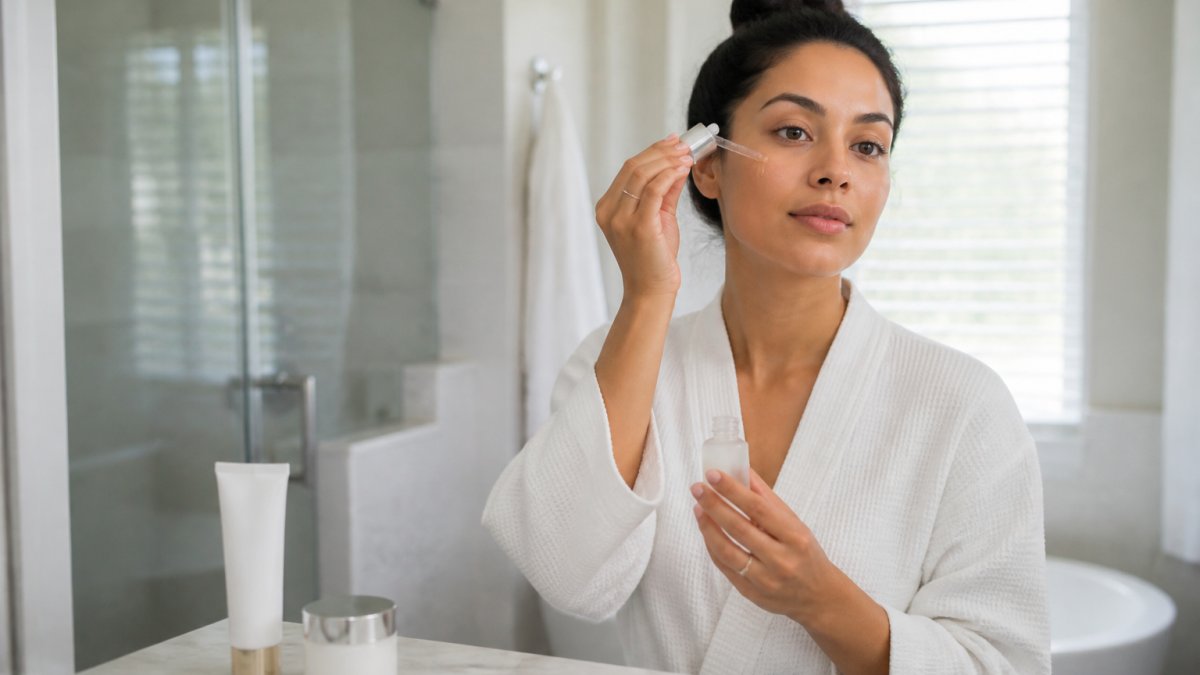
Morning Steps That Protect and Brighten
- Cleanse gently. A mild, non-foaming cleanser removes overnight residue without stripping the barrier.
- Apply vitamin C. A stable L-ascorbic acid or derivative serum neutralizes free radicals and adds a second layer of defense against new pigment.
- Moisturize. Hydration keeps the barrier intact, which reduces the irritation that makes pigmentation worse.
- Finish with broad-spectrum SPF 30 or higher. Reapply every two hours outdoors.
The sunscreen step is non-negotiable. Reapplication matters as much as the initial layer.
Evening Steps That Repair and Fade
- Remove sunscreen and makeup fully. Double cleansing works well if you wear heavy SPF.
- Apply your active. Alternate nights between a retinoid and a brightening agent rather than layering both.
- Follow with a barrier moisturizer. Ceramides and niacinamide calm the skin overnight.
Keep the evening routine boring and repeatable. Rotation is where most people go wrong.
Best Ingredients for Hyperpigmentation
The best ingredients for hyperpigmentation fall into two groups: those that interrupt pigment production and those that speed up cell turnover. You need one from each group, not five from one.
Tyrosinase Inhibitors and Brightening Agents
Tyrosinase inhibitors are compounds that interfere with the enzyme driving melanin production. The evidence-backed options include:
- Niacinamide, reduces pigment transfer and strengthens the skin barrier
- Tranexamic acid, particularly useful for melasma and stubborn patches
- Alpha arbutin and kojic acid, gentler tyrosinase inhibitors suited to sensitive skin
Start with one. Adding three at once makes it impossible to tell what is working and raises irritation risk.
Retinoids and Chemical Exfoliation
Retinoids accelerate cell turnover, pushing pigmented cells to the surface faster. Prescription tretinoin is the most studied; over-the-counter retinol is a gentler entry point. Both increase photosensitivity, so sunscreen becomes even more critical.
Chemical exfoliation with salicylic acid or lactic acid clears dull surface cells and helps other actives penetrate. Use it two to three nights per week, not nightly.
How to Fade Dark Spots Without Irritation
Fading dark spots without irritation comes down to four rules: go slow, patch test, sequence correctly, and treat the barrier as part of the treatment. Most guides stop at the first two. The sequencing and barrier rules are where routines actually succeed or fail.
The What-Not-to-Mix Matrix
Irritation-induced pigmentation is the most common self-inflicted setback in a brightening routine. When two actives compete for the same skin real estate, the barrier loses, inflammation rises, and melanocytes respond by producing more pigment, the opposite of the goal. Use this as a hard rule set, not a suggestion:
| Combination | Verdict | Why |
|---|---|---|
| Retinoid + benzoyl peroxide | Avoid same night | Benzoyl peroxide can degrade certain retinoids and the pair is highly irritating |
| Retinoid + AHA/BHA acid | Avoid same night | Both accelerate turnover; together they strip the barrier |
| Vitamin C + benzoyl peroxide | Separate | Oxidation conflicts and irritation risk |
| Vitamin C + niacinamide | Generally fine | Older concern about flushing is not supported at typical cosmetic concentrations |
| Vitamin C + sunscreen | Layer, AM | Vitamin C supports the antioxidant defense SPF provides |
| Niacinamide + retinoid | Generally fine | Niacinamide can buffer retinoid irritation for many users |
| AHA/BHA + niacinamide | Generally fine | Pair on alternate nights if sensitive |
| Tranexamic acid + vitamin C | Generally fine | Different mechanisms, low conflict |
| Azelaic acid + retinoid | Caution | Both can sting; introduce one at a time |
| Two tyrosinase inhibitors together | Unnecessary | No added benefit, added irritation risk |
A simple rule that covers most of the table: one turnover active per night, one antioxidant in the morning, and never two acids in the same session.
A Barrier-Repair Protocol
When your skin stings, flakes, or turns red easily, you are not 'purging', you are damaging the moisture barrier, and damaged barriers produce more pigment. Pause all actives and run this reset for 7-14 days:
- Cleanser: a non-foaming, fragrance-free cleanser, once at night only. Rinse with water in the morning.
- Moisturizer: ceramides, cholesterol, and fatty acids, the three lipids skin uses to rebuild its barrier. Apply to damp skin.
- Occlusive at night: a thin layer of petrolatum or a petrolatum-based balm over the moisturizer if you are very dry.
- SPF every morning: mineral or chemical, your choice, but do not skip it. UV slows barrier recovery.
- No exfoliation, no retinoid, no vitamin C until stinging stops for at least three consecutive days.
Once the barrier is calm, reintroduce actives one at a time using the tolerance ladder below.
The Tolerance Ladder
- Start with the active twice weekly for two weeks.
- Increase to every other night if there is no reaction.
- Add a second active only after the first is fully tolerated, and never on the same night.
- Pause all actives if your barrier is compromised, and return to cleanser, moisturizer, and SPF.
Patch testing is the step almost everyone skips. Apply a small amount of a new active behind your ear or on your jawline for three nights before using it on your whole face. If redness or burning appears, stop.
Professional Hyperpigmentation Treatment Options
Home care has a ceiling. When pigment sits deeper, or when melasma keeps returning despite a disciplined routine, in-office treatment is what moves the needle.
This is where the budget question gets honest. A strong home routine manages pigment. It rarely resolves dermal pigment or long-standing sun damage on its own.
| Approach | What It Targets | Typical Role |
|---|---|---|
| Home routine (SPF, actives, moisturizer) | Epidermal pigment, prevention | Daily maintenance |
| Corrective peels | Surface pigment, texture, dullness | Periodic resurfacing |
| Microneedling | Dermal pigment, scarring, firmness | Series-based correction |
For anyone weighing professional treatment, the U.S. Food and Drug Administration's information on cosmetic treatments is a useful starting point for understanding how these procedures are regulated.
At S. Corbin Esthetics, every treatment plan pairs in-office work with a home regimen.
Common Mistakes That Worsen Pigmentation
The mistakes that worsen pigmentation are predictable, and most of them come from doing too much rather than too little. The list below separates the errors that slow progress from the errors that actively reverse it, and ends with the phase most routines never plan for.
Mistakes That Slow Progress
- Skipping sunscreen on cloudy days. UV passes through cloud cover, and pigment does not take days off.
- Using actives nightly from day one. Tolerance is built, not assumed.
- Mixing too many brightening agents. More ingredients do not mean faster fading; they mean more irritation.
Mistakes That Reverse Progress
- Stopping actives the moment spots fade. Without maintenance, melasma and sun-induced pigment recur, often within a season.
- Switching products every few weeks. No single active gets a fair trial, and the barrier pays the price.
- Adding a new active during a flare. Flares are a signal to simplify, not to escalate.
The Maintenance Phase Most Routines Skip
Fading is the first project. Keeping the result is the second, and it is the one almost no guide plans for. Once your spots have visibly faded, typically after 8-16 weeks of consistent care, do not stop everything. Step down instead:
- Keep SPF daily, forever. This is the non-negotiable maintenance step. Reapply every two hours outdoors.
- Reduce your primary active to 2-3 nights per week. Enough to hold the result, not enough to keep irritating.
- Keep one antioxidant in the morning. Vitamin C or a derivative, daily.
- Keep a barrier moisturizer in the rotation. Ceramides and niacinamide, every night.
- Add a maintenance peel or in-office session 2-4 times per year if you were treating dermal pigment or melasma.
- Reassess seasonally. Pigment behaves differently in summer and winter; adjust frequency, not products.
Conclusion
Pigmentation is stubborn, and the honest truth is that most people plateau with home care alone.
S. Corbin Esthetics builds customized plans that combine corrective treatments like microneedling and corrective keratolytic peels with a targeted home regimen, guided by our medical director, Dr.
Book Now with S. Corbin Esthetics and start a routine built for your skin, not a generic one.
Frequently Asked Questions
What is the best skincare routine for hyperpigmentation?
A consistent AM and PM routine that combines sun protection, brightening ingredients, and gentle exfoliation. In the morning, use a vitamin C serum, moisturizer, and broad-spectrum SPF 30 or higher. At night, cleanse, apply a retinoid or alpha arbutin serum, and moisturize. Add a chemical exfoliant like salicylic acid two to three times weekly. This approach addresses melanin production, cell turnover, and sun damage.
How important is sunscreen when treating pigmentation?
Sunscreen is non-negotiable. UV exposure triggers melanin production and undoes progress from brightening ingredients. Apply a broad-spectrum SPF 30 or higher every morning, even on cloudy days, and reapply every two hours if you are outdoors. Without daily sun protection, dark spots will continue to darken and new ones will form, making other treatments far less effective.
What skincare ingredients can help fade dark spots?
Look for tyrosinase inhibitors like alpha arbutin, kojic acid, and tranexamic acid, which reduce melanin production. Niacinamide and azelaic acid also help even skin tone. Vitamin C provides antioxidant protection and brightening. Retinoids speed cell turnover to fade existing spots. For post-inflammatory hyperpigmentation, azelaic acid and niacinamide are especially useful. Introduce one active at a time to avoid irritation.
How long does it take for a skincare routine to improve pigmentation?
Visible improvement typically takes 8 to 12 weeks of consistent use. Dark spots fade gradually as the skin cycles through cell turnover. Post-inflammatory hyperpigmentation from acne may resolve faster than melasma, which can take months. Professional treatments like chemical peels or microneedling can accelerate results but still require home care to maintain. Patience and daily sunscreen are key.
Can exfoliating products make pigmentation worse?
Yes, over-exfoliating can damage the skin barrier and trigger inflammation, which may worsen hyperpigmentation, especially in darker skin tones. Use chemical exfoliants like salicylic acid or lactic acid no more than two to three times per week. Avoid harsh scrubs. If you notice redness, stinging, or increased darkening, stop exfoliating and focus on barrier repair with ceramides and gentle cleansing.
When should you consider professional treatment for pigmentation?
Consider professional treatment if at-home routines have not produced noticeable improvement after three to four months, or if you have melasma, sun damage, or acne scars that are resistant to topical products. In-office options like corrective peels, microneedling, and laser therapy can target deeper pigment. A consultation with a licensed esthetician or dermatologist can determine the safest and most effective plan for your skin type and concerns.